Restaurant Menu Design: Psychology, Pricing & Layout That Sells
Learn the science of menu design and pricing psychology. Discover how layout, descriptions, and strategic pricing can increase your average check by 15-30%.
Your menu is your most powerful sales tool. A well-designed menu doesn't just list items and prices - it guides customers toward profitable choices while enhancing their dining experience.
---
The Psychology of Menu Design
Research shows that customers spend an average of only 109 seconds looking at a menu. In that time, their eyes follow predictable patterns, and their brains respond to specific visual and psychological cues.
The Golden Triangle
Studies using eye-tracking technology reveal that customers' eyes follow a predictable pattern called the "Golden Triangle":
Place your highest-profit items in these prime locations.
The Decoy Effect
By strategically placing a high-priced "decoy" item near your target item, you make the target seem more reasonably priced. For example:
| Item | Price | Role |
|------|-------|------|
| Premium Ribeye | $65 | Decoy |
| Filet Mignon | $48 | Target (high profit) |
| Sirloin | $32 | Budget option |
Most customers will choose the Filet Mignon, feeling they're getting value compared to the Ribeye.
---
Menu Layout Best Practices
Optimal Menu Structure
Single Page vs. Multi-Page
| Format | Best For | Advantages |
|--------|----------|------------|
| Single page | Fast-casual, limited menu | Quick decisions, lower printing costs |
| Bi-fold | Casual dining | Good scanning, balanced options |
| Tri-fold | Full-service | More categories, wine list space |
| Multi-page | Fine dining, extensive wine | Premium feel, detailed descriptions |
Category Organization
Arrange categories strategically:
The Power of White Space
Cluttered menus overwhelm customers and slow decisions. Guidelines:
- Limit each category to 5-7 items maximum
- Use adequate spacing between items
- Avoid walls of text
- Let high-profit items breathe with extra space around them
---
Writing Menu Descriptions That Sell
Research from Cornell University shows that descriptive menu labels can increase sales by 27% and improve customer satisfaction.
The Anatomy of a Great Description
Basic description: "Grilled Salmon"
Optimized description: "Atlantic Salmon, Cedar-Planked and Slow-Roasted with House-Made Lemon Dill Butter, Served with Roasted Fingerling Potatoes and Seasonal Vegetables"
Power Words That Sell
| Category | Words That Work |
|----------|----------------|
| Origin | "House-made," "Local," "Farm-raised," "Imported" |
| Preparation | "Slow-roasted," "Hand-crafted," "Wood-fired," "Pan-seared" |
| Sensory | "Crispy," "Tender," "Creamy," "Zesty," "Smoky" |
| Premium | "Premium," "Select," "Prime," "Signature" |
| Nostalgic | "Grandma's," "Traditional," "Classic," "Old-fashioned" |
Description Length Guidelines
| Restaurant Type | Description Length |
|-----------------|-------------------|
| Fine dining | 25-40 words |
| Casual dining | 15-25 words |
| Fast-casual | 8-15 words |
| QSR | 5-10 words |
---
Strategic Menu Pricing
Remove the Dollar Sign
Studies show that removing dollar signs increases spending by 8-12%. Instead of "$28.00", simply write "28" or "28.".
Avoid Price Columns
When prices align in a column, customers scan down the column comparing prices rather than reading descriptions. Scatter prices at the end of descriptions to encourage reading.
The .95 vs .00 Debate
| Price Ending | Perception | Best For |
|--------------|------------|----------|
| .95 / .99 | Value, deal-seeking | Fast-casual, value concepts |
| .00 | Quality, premium | Fine dining, upscale casual |
| .50 | Middle ground | Casual dining |
Nested Pricing
Bundle items strategically:
- "Add grilled shrimp +8" (not +$8.00)
- "Make it a double +6"
- "Pair with our House Wine +14"
---
Menu Engineering: The Profitability Matrix
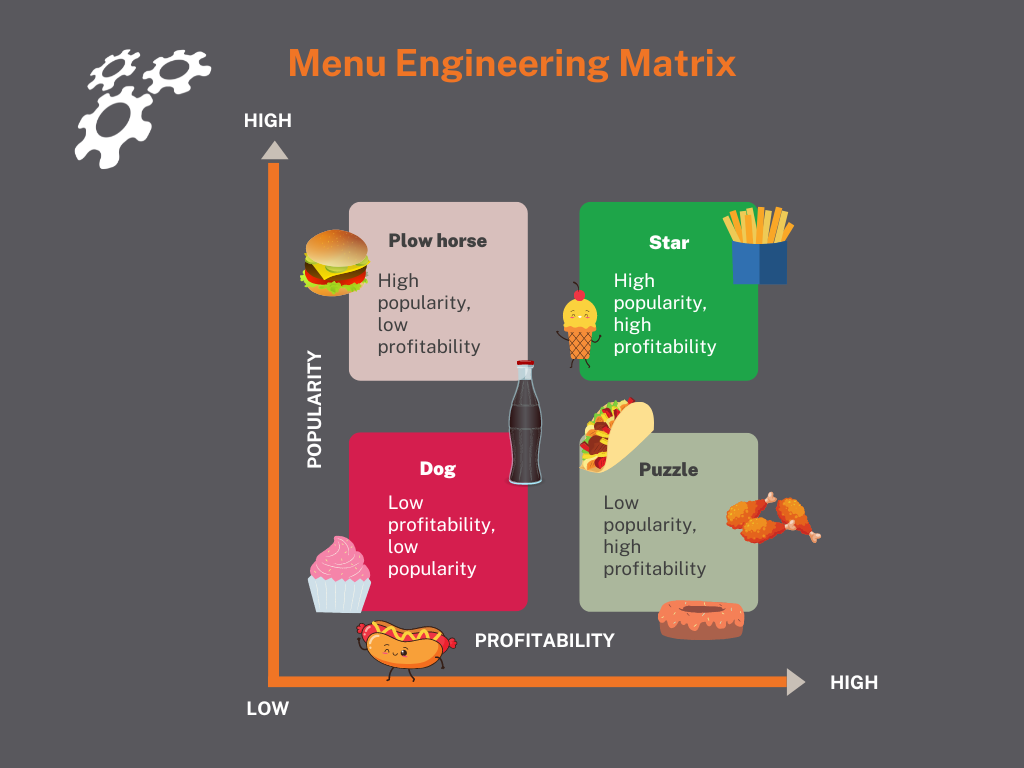
Menu engineering categorizes items by popularity and profitability:
The Four Categories
| Category | Popularity | Profitability | Strategy |
|----------|------------|---------------|----------|
| Stars | High | High | Promote heavily, maintain quality |
| Plow Horses | High | Low | Raise prices or reduce cost |
| Puzzles | Low | High | Improve positioning, descriptions |
| Dogs | Low | Low | Consider removing |
Action Steps by Category
Stars (High popularity, high profit)
- Feature in prime menu locations
- Train servers to recommend
- Never discount
- Maintain quality at all costs
- Reduce portion size slightly
- Increase price gradually (2-3% at a time)
- Substitute less expensive ingredients
- Add profitable add-ons
- Move to better menu position
- Rewrite descriptions
- Train servers to recommend
- Add photos if appropriate
- Remove from menu
- Or dramatically reinvent
- Use ingredients elsewhere
---
Visual Design Elements
Typography
| Element | Recommendation |
|---------|---------------|
| Font families | Maximum 2-3 |
| Body text size | 11-12pt minimum |
| Category headers | Bold, larger size |
| Prices | Same size as descriptions |
| Descriptions | Easy-to-read serif or sans-serif |
Color Psychology
| Color | Association | Use For |
|-------|-------------|--------|
| Red | Appetite, urgency | Specials, featured items |
| Orange | Enthusiasm, warmth | CTAs, highlights |
| Green | Fresh, healthy | Salads, vegetarian options |
| Brown | Earthiness, comfort | Rustic concepts |
| Black/Gold | Luxury, elegance | Fine dining |
Photos: To Use or Not?
| Concept | Photo Recommendation |
|---------|---------------------|
| Fine dining | Avoid (perceived as low-end) |
| Casual dining | Sparingly (1-3 hero shots) |
| Fast-casual | Recommended (improves ordering speed) |
| QSR | Essential (above counter displays) |
---
Special Sections and Callouts
Effective Callout Boxes
- "Chef's Recommendation" - Signals quality, boosts sales 20%+
- "House Favorite" - Social proof
- "New" - Attracts adventurous diners
- "Seasonal" - Creates urgency
- "Gluten-Free" / "Vegan" - Meets dietary needs
Kids Menu Strategy
- Keep it simple (5-7 items)
- Include one healthy option
- Price attractively (parents notice)
- Include a beverage in combos
- Consider activity placemat version
---
Digital Menu Considerations
QR Code Menus
Advantages:
- Easy to update prices
- No printing costs
- Can include photos and videos
- Track popular items
- Battery/connectivity issues
- Less personal
- Older demographics may struggle
- Harder to upsell
Best Practice
Offer both digital and physical options. Use digital for wine lists and specials that change frequently.
---
Menu Testing and Optimization
A/B Testing Strategies
- Test different descriptions for the same item
- Try different menu positions
- Experiment with pricing ($28 vs. $27 vs. $29)
- Test with and without photos
Key Metrics to Track
| Metric | Target | How to Track |
|--------|--------|-------------|
| Food cost per item | 28-32% | Recipe costing |
| Item popularity | Top 20% of items = 80% of sales | POS data |
| Average check | Increasing trend | POS reports |
| Attachment rates | Sides, drinks, desserts | Server tracking |
---
Common Menu Mistakes to Avoid
---
Menu Refresh Checklist
Review your menu quarterly with this checklist:
- [ ] Remove items selling less than 5% of category volume
- [ ] Analyze food costs for every item
- [ ] Update descriptions for puzzles and new items
- [ ] Adjust prices for cost increases
- [ ] Check placement of stars and high-margin items
- [ ] Review and refresh photos if used
- [ ] Test new items in specials before adding permanently
- [ ] Gather server feedback on customer questions/confusion
---
Key Takeaways
A strategically designed menu can increase your average check by 15-30% without adding a single customer. Remember:
Need help engineering your menu for maximum profitability? Our Menu Engineering Tool analyzes your items and provides specific recommendations to boost your bottom line.